

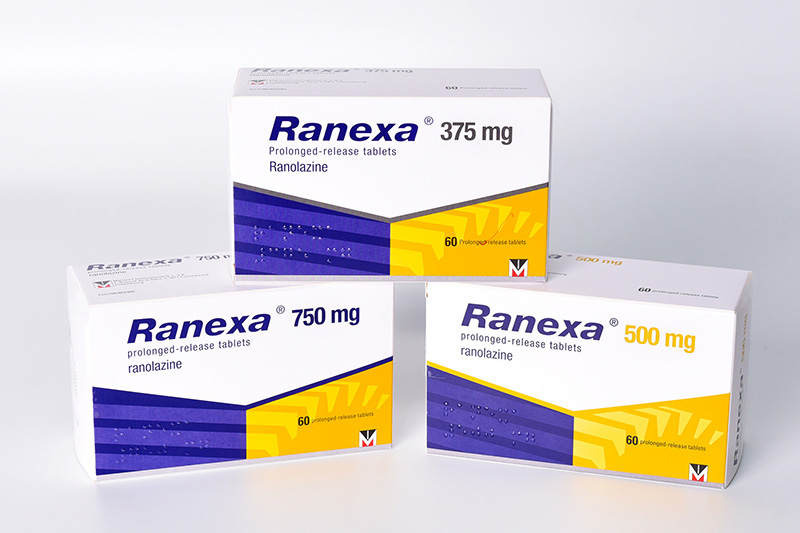

Ranexa is indicated as add-on therapy for the symptomatic treatment of patients with stable angina pectoris who are inadequately controlled or intolerant to first-line antianginal therapies (such as beta-blockers and/or calcium antagonists).
Product Information

Abbreviated Prescribing Information: Ranexa (ranolazine).
Please consult the Summary of Product Characteristics (SmPC) for full prescribing information.
Presentation: Prolonged-release tablets containing 375 mg, 500 mg or 750 mg of ranolazine. 750 mg tablet contains E102 and lactose.
Use: Ranexa is indicated as add-on therapy for the symptomatic treatment of patients with stable angina pectoris who are inadequately controlled or intolerant to first-line antianginal therapies (such as beta-blockers and/or calcium antagonists).Dosage and administration: Oral administration. Patients should be instructed to list their medication to their health care professional at each visit. Adults: Initial dose is 375 mg twice daily. After 2-4 weeks, dose should be titrated to 500 mg twice daily and, according to patient’s response, further titrated to 750 mg twice daily. Concomitant treatment with moderate CYP3A4 and P-glycoprotein (P-gp) inhibitors: Careful dose titration is recommended. Renal impairment: Careful dose titration is recommended in mild to moderate renal impairment, and contraindicated in severe renal impairment. Hepatic impairment: Careful dose titration is recommended in mild hepatic impairment, and contraindicated in moderate to severe hepatic impairment. Elderly: Dose titration in the elderly should be exercised with caution. Low weight: Dose titration in patients with low weight should be exercised with caution. Congestive Heart Failure (CHF): Dose titration in moderate to severe CHF should be exercised with caution. Paediatric patients: No data in children below the age of 18 years. Ranexa tablets should be swallowed whole and not crushed, broken or chewed. They may be taken with or without food. Contraindications: Hypersensitivity to the active substance or to any of the excipients. Severe renal impairment. Moderate or severe hepatic impairment. Concomitant administration of potent CYP3A4 inhibitors. Concomitant administration of Class Ia or Class III antiarrhythmics other than amiodarone. Warnings and Precautions: Caution should be exercised when prescribing or up titrating ranolazine to patients in whom an increased exposure is expected. QT prolongation: Caution should be observed when treating patients with a history of congenital or a family history of long QT syndrome, in patients with known acquired QT interval prolongation, and in patients treated with drugs affecting the QTc interval.
Interactions: Co-administration with CYP3A4 inducers is expected to lead to lack of efficacy.
Renal impairment: Check renal function at regular intervals during treatment.Interactions: CYP3A4 inhibitors: Increase plasma concentrations of ranolazine. Combining ranolazine with potent CYP3A4 inhibitors is contraindicated. CYP3A4 inducers: Avoid initiation with Ranexa during administration of CYP3A4 inducers. CYP2D6 inhibitors: May increase plasma concentrations of ranolazine. Effect of ranolazine on other medicinal products: Dosage adjustment of sensitive CYP3A4 substrates and CYP3A4 substrates with a narrow therapeutic range may be required. Lower doses of CYP2D6 substrates may be required. Caution with CYP2B6 substrates. Monitor digoxin levels following initiation and termination of Ranexa. Limit dose of simvastatin to 20mg once daily in patients taking Ranexa. Limit dose of atorvastatin and consider clinical monitoring in patients taking Ranexa. Monitor blood levels of tacrolimus when co-administering with Ranexa and adjust tacrolimus dose accordingly. Also recommended for other CYP3A4 substrates with a narrow therapeutic range. Drugs transported by the Organic Cation Transporter-2 (OCT2): Plasma exposure of metformin increased in subjects with type 2 diabetes mellitus when co-administered with Ranexa. The exposure of other OCT2 substrates may also be affected. Theoretical risk that concomitant treatment with drugs known to prolong the QTc interval may increase the possible risk of ventricular arrhythmias.Pregnancy and lactation: Ranexa should not be used during pregnancy unless clearly necessary. Ranexa should not be used during breast-feeding. Effect on fertility unknown.Side-effects: Generally mild to moderate in severity and often develop within the first 2 weeks of treatment. Common (1-10%): dizziness, headache, constipation, vomiting, nausea, asthenia. Uncommon (0.1–1%): anorexia, decreased appetite, dehydration, anxiety, insomnia, confusional state, hallucination, lethargy, syncope, hypoaesthesia, somnolence, tremor, postural dizziness, paraesthesia, blurred vision, visual disturbance, diplopia, vertigo, tinnitus,
hot flush, hypotension, dyspnoea, cough, epistaxis, abdominal pain, dry mouth, dyspepsia, flatulence, stomach discomfort, pruritus, hyperhydrosis, pain in extremity, muscle cramp, joint swelling, muscular weakness, dysuria, haematuria, chromaturia, fatigue, peripheral oedema, increased blood creatinine, increased blood urea, prolonged QT corrected interval, increased platelet or white blood cell count, decreased weight. In a long term study, acute renal failure was also reported with an incidence less than 1% in placebo and ranolazine patients. Rare (0.1-0.01%): hyponatremia, disorientation, amnesia, depressed level of consciousness, loss of consciousness, coordination abnormal, gait disturbance, parosmia, impaired hearing, peripheral coldness, orthostatic hypotension, throat tightness, pancreatitis, erosive duodenitis, oral hypoaesthesia, angioedema, allergic dermatitis, urticaria, cold sweat, rash, acute renal failure, urinary retention, erectile dysfunction, elevated levels of hepatic enzyme. Not known: myoclonus. Increased incidence of congestive heart failure and transient ischaemic attacks seen in patients with history of chronic angina who had incomplete revascularisation after percutaneous coronary intervention and treated within 2 weeks with ranolazine (1000 mg twice daily [dose not approved in Europe]) in a placebo-controlled post-PCI trial.
Elderly, renal impairment and low weight: In general, adverse events occurred more frequently among elderly patients and patients with renal impairment. Adverse events in patients with low body weight were similar to those of patients with higher weight. Please consult the SPC for further information.Pack size: 60 tablets. Legal category: POM.
Marketing Authorisation Holder: AMenarini International Operations Luxembourg S.A.
Marketing Authorisation Number: EU/1/08/462/001, 003, 005.
Marketed by: A. Menarini Pharmaceuticals Ireland Ltd., Castlecourt, Monkstown Farm, Monkstown, Glenageary, Co. Dublin A96 T924.
Further information is available on request to A. Menarini Pharmaceuticals Ireland Ltd or may be found in the SmPC.
Last updated: October 2020
IR-MEN-18-2023 Date of Preparation: August 2023